US Consul General Meets with Local Business Leaders to Hear Concerns and Provide Information
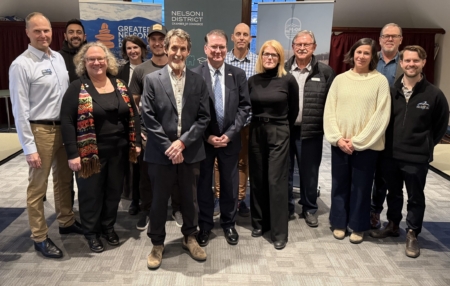
US Consul General Shawn Crowley with a group of local business leaders at a special meeting in late-November at the Nelson & District Chamber of Commerce.
Diplomat Shares Messages from Washington and Fields Questions
Greater Nelson business leaders had the opportunity to sit down with a senior United States diplomat to discuss cross-border relationships and current trade tensions between the two nations.
U.S. Consul General Shawn Crowley visited Nelson in late November as part of his ongoing work to strengthen ties and deliver messages from Washington. One of his stops was at the Nelson & District Chamber of Commerce where he sat down with 15 business leaders representing a cross-section of sectors including forestry, manufacturing and tourism.
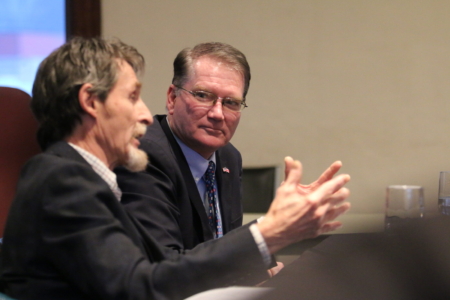
US Consul General Shawn Crowley speaking with sector leaders where listening from both sides was the goal.
“The smaller businesses are really the key to the relationship because you don’t have the resources to go look for markets in Asia or in Africa,” says Crowley. “You’ve got ties already across the border to producers and to customers on the other side. And that’s the way it’s been in the past, and that’s the way it’s going to be in the future. But it is important for those businesses to have certainty, so they understand what the costs are going to be and whether they should invest additionally or not.”
A career diplomat with more than three decades of experience in the U.S. Foreign Service, Crowley took up his Vancouver-based posting in the summer of 2025 as the highest-ranking American diplomat in British Columbia.
His extensive diplomatic career includes senior postings in Italy and the Netherlands, as well as a previous assignment at the U.S. Embassy in Ottawa where his responsibilities included fisheries, border negotiations and cross-border First Nations issues.
With a mandate that covers British Columbia and the Yukon, Crowley’s role includes strengthening economic and diplomatic ties, engaging with regional business and community leaders, and providing insight to decision-makers in Ottawa and Washington on issues impacting the relationship between the two countries.
“He’s clearly going to look after U.S. interests, but he came to our community to hear what we had to say and I think that’s great,” says Tom Thomson, executive director for the local Chamber. “Our business community has been very resilient. We want to freely access the important U.S. market, and have a positive relationship with U.S. citizens so they continue to travel to our region. You want to make sure that you maintain positive relations with both countries and it has been challenging over the last two years.”
Tension on Both Sides of the Border
Throughout the hour-long session, Crowley stressed that trade disputes between the countries are nothing new. He pointed to the up-and-down relationship over softwood lumber that has been a constant source of diplomatic activity for more than four decades.
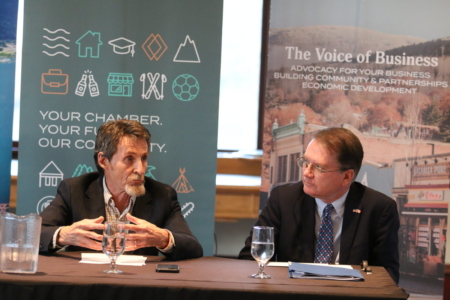
Chamber ED Tom Thomson (left) breaks down the background on Greater Nelson and discusses current key challenges to US Consul General Shawn Crowley.
Despite the temperature being turned up in the last two years, Crowley stressed that the two economies are “intertwined” and that has not changed.
“We should look beyond the headlines and look beyond what’s on social media,” says Crowley. “We had $3.3 billion a day in trade going back and forth across the border before the current tariffs, we still have $3.2 billion going across the border. Over 75 per cent of that doesn’t have a single penny of tariffs on it. So those are things that people would never understand if they just looked at the social media headlines.”
While the majority of goods continue to flow across the border without tariffs under the Canada-United States-Mexico Agreement (CUSMA), the ongoing trade dispute has had a concentrated impact on several Canadian industries, including steel, aluminum, automotive manufacturing and forestry.
Crowley said that Canada and China are the only two nations to impose retaliatory tariffs on the United States during the current trade dispute. He also cited Canada’s exploration of closer ties with the European Union, as well as former premier David Eby’s calls for British Columbians to avoid traveling south of the border and the removal of American liquor from provincial store shelves.
“That’s not the downplay the real frustrations and the real serious issues for certain industries, and especially ones here in the region with lumber and with some of the mining sector,” Crowley added. “But those are more specialty questions that the federal governments are working on between Ottawa and Washington.”
Keeping Positive Relationships Going During Tough Times
Prior to meeting with the Chamber group, Crowley spent time with Mayor Janice Morrison where the two discussed the ongoing connection between Greater Nelson and the United States that stretches back to the late-1800s.
In Nelson’s formative years, there was actually a U.S. Consulate office located on Stanley Street in the old Strathcona Hotel, now the site of the Nelson Police Department building. The consulate was was placed there to assist U.S. citizens during the mining and railway boom of the late-1800s and early-1900s.
Though her visit was focused primarily on the positive aspects of the relationship, Morrison was hopeful that Crowley returned to his office in Vancouver with better understanding from rural British Columbia.
“He realizes that there are concerns here, that we still have concerns about the current government and the leader of the government in the United States,” says Morrison. “We’re looking for some more stability and less uncertainty. Democrats have also been protectionists when they are in office, so tariffs are not going to disappear completely. We need to have stability and that’s really the key. It would be nice is to see smooth water going forward and a little less turbulence.”
Crowley agreed that forming better understanding on both sides of the border will be vital for the relationship moving forward.
“We’re hearing similar things that we hear from businesses throughout the province and the territory that we cover, it all boils down to the fact we need to get to some kind of certainty in the way forward,” Crowley says. “In my visit here, it’s interesting to hear more of the comments from lumber and mining because that’s so important in this region. Those are two key industries in the United States, too. And in both of those sectors, we also have a lot of businesses that invest in both sides of the border. When they announce a mill closure here, sometimes people overlook that the next sentence announces two mill closures in the United States. So this is not just an issue in Canada and this is not just issue in the United States, it’s an issue for both of us.”
Thomson and most of the local business leaders gathered at the meeting agreed that certainty was a key takeaway from Crowley’s visit.
“I think he’s going to take the message back that Canadians want to see progress,” says Thomson. “They want to see some kind of certainty, and they want to see an opportunity for trade to continue back and forth with the least amount of restrictions as possible. Let’s try to get some certainty for both sides of the border.”
Learn more about the Nelson & District Chamber of Commerce here.